A Room-by-Room Reset for Everyday Household Clutter
Use a practical sequence to sort household items by purpose, choose a home for frequently used belongings, and make each room easier to maintain.
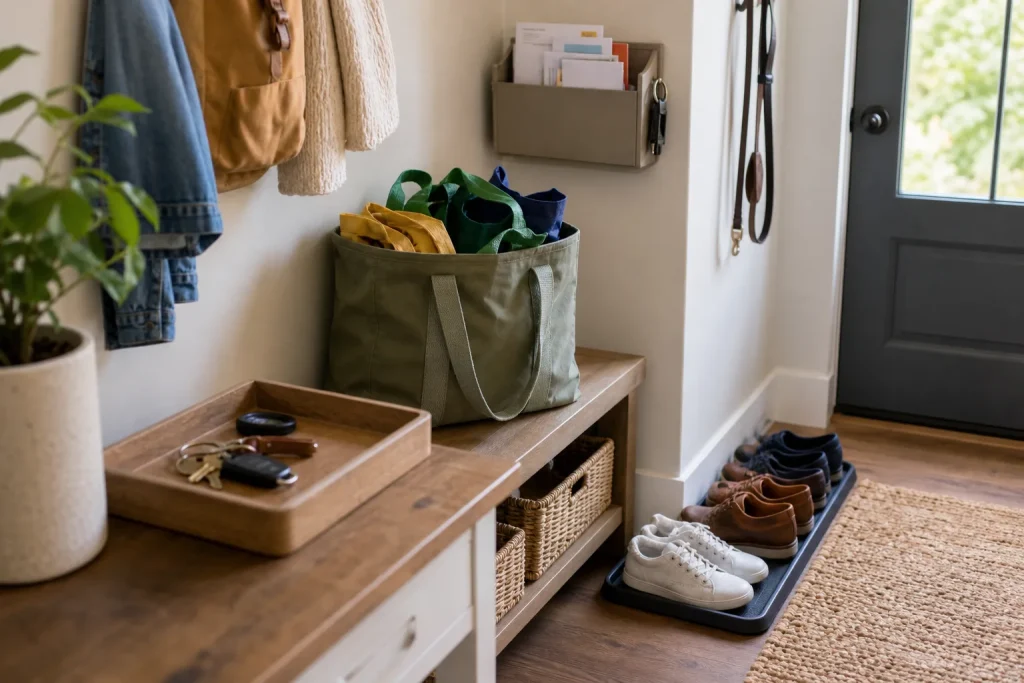
Clutter is often a mismatch: something needed for an activity is hard to reach, while something with no clear role occupies the room’s most useful spot. A household reset can correct that mismatch without turning every room into a display space. The aim is to make ordinary routines smoother, not to remove belongings indiscriminately or create a system that only works when everyone remembers a complicated set of rules.
Think of each room as a setting for particular tasks. A useful arrangement gives the objects for those tasks a clear, convenient home and makes it easy to notice what belongs elsewhere. Start with one contained area, make decisions based on use and condition, and observe how the room works afterward. A completed section is valuable even if the rest of the home remains untouched for now.
Notice What the Room Asks You to Do
Rather than beginning with a list of objects, pay attention to the room’s daily routines. In an entryway, people may arrive carrying shoes, bags, keys, and mail. In a kitchen, they may prepare food, wash dishes, and pack items to take elsewhere. These activities reveal what the room needs to support. An object need not be used constantly to belong there, but its presence should make sense in relation to a real task.
Watch where belongings collect naturally and what gets in the way. A counter covered with unrelated objects may leave little room for preparation; a chair used as a landing spot may signal that bags or clothes lack a convenient home. Treat these patterns as clues about the arrangement, not as evidence that anyone is careless. Before buying organizers or shifting furniture, identify the particular task that feels awkward and the objects involved.
Give One Small Area Your Attention
Choose a single drawer, shelf, basket, or surface. Bring its contents into view and make a decision about each item: keep it here, move it to a more suitable room, pass it along if it is usable and wanted, or discard it if it is no longer fit for use. If a decision depends on another household member, place the item in a clearly defined review spot and ask them before deciding. This keeps uncertainty from spreading across the whole area.
Keep the work contained so the room remains usable. A mixed pile from multiple cupboards can make it harder to see what belongs together and harder to stop at a sensible point. When an item’s place is uncertain, ask what activity it supports and where that activity happens. If it belongs elsewhere, take it to that destination when practical; if its destination is still unclear, do not quietly assign it to an inconvenient corner just to finish sorting.
Make Storage Follow the Activity
Place frequently used objects close to the task they support. Cooking utensils are easier to return near the preparation area; a bag used for outings may make sense near the exit. Related items can share a home, provided the grouping remains easy to understand. Less frequently used belongings can occupy less accessible spaces, while everyday items should not require moving a stack or opening several containers before they are available.
Test a proposed home against the effort of both taking something out and putting it back. A high shelf may be unsuitable for an object used by a child or someone with limited reach; a container with a fiddly lid may discourage anyone from using it. If an item is needed in two rooms, consider whether one shared home is practical or whether separate copies are already available. Choose based on the household’s actual routine rather than an idealized one.
Keep Relocations From Becoming Clutter
Moving objects to their proper rooms can help finish a section, but a relocation pile can become another obstacle. If carrying items one by one would interrupt the task, use a basket temporarily and empty it before beginning another area. Keep it out of walkways while sorting. The useful question is not whether the basket looks orderly; it is whether every item inside has a decided destination and gets there.
Some belongings need a conversation rather than a quick move. Ask who uses the item and whether its current room is important to that person. For donations or disposal, consider whether an item is suitable to pass on and follow local rules for discarding anything that needs special handling. If no one can identify a sensible purpose or location, make that an explicit household decision instead of allowing the object to circulate from one temporary surface to another.
Check Whether the New Home Works
After putting things away, use the room for its ordinary task and notice where the arrangement causes hesitation. Can someone take out the needed object and return it without shifting other belongings? Does the route through the room stay clear? If the answer is no, try a different location or reduce the number of items competing for that space. Leave some room for everyday arrivals, such as mail or shopping, rather than treating every shelf as a place that must be filled.
Simple cues can help a household share the arrangement: keys return to one tray, shoes go to a designated area, and papers wait in a single review spot. The cue should be easy to follow and visible to the people who use it. If belongings repeatedly land somewhere else, reconsider whether their assigned homes are convenient. Adjusting a system to fit a changing routine is more useful than expecting everyone to follow an awkward arrangement indefinitely.
Work Through a Fully Worked Example
Hypothetical example: Imagine an entryway with keys buried under shopping bags, shoes narrowing the route to the door, and reusable bags scattered over a bench. The household has no spare furniture and wants to keep the passage usable. First, they clear the bench and separate keys, reusable bags, mail, shoes, and unrelated objects. They move the mail to an existing paper-review spot and return unrelated objects to their known rooms. These actions leave the entryway belongings visible for decisions rather than mixed together.
Next, they place the keys in an existing tray beside the exit, line the shoes along the wall without blocking the route, and fold the reusable bags into one larger bag kept beside the shoes. They then walk through the passage and pretend to leave, checking whether the door area remains clear and whether each item can be returned easily. The expected observable result is a clearer route and recognizable homes for departure items. The tradeoff is that household members must put shoes and bags back in those places; if the route still feels cramped, they can reduce the number of shoes kept there or choose a different location for the bags.
Conclusion: Let Daily Use Set the Standard
A household reset works best when it responds to how people actually use their rooms. Begin with a task, identify the objects that support it, and give those objects homes that are convenient to reach and restore. Sorting one area at a time limits disruption, while conversations about shared belongings prevent quick decisions from creating new friction.
Start with the room or surface that causes the clearest daily inconvenience. Once the area is arranged, check it during ordinary use and change any placement that repeatedly fails. The goal is not a flawless home or a rigid routine. It is a more understandable relationship between rooms, activities, and belongings, so the next tidy-up has a clear place to begin.