Start a Creative Project Before You Have the Perfect Idea
Turn a passing curiosity into a small draft, sketch, or model. Compare practical creative prompts, follow a worked example, and decide what to try next.
A creative idea often begins as a tug rather than a plan: a color pairing you keep noticing, a sound that interrupts your thoughts, or a scene you want to imagine. Waiting for that fragment to become a complete concept can make beginning feel like a test. Instead, use a small act of making to discover what the idea might become. The aim is not to produce polished work on demand; it is to create something you can look at, read, or handle and use to choose a next move.
Different prompts suit different materials and moods. You might write a few lines, sketch a shape, or arrange scraps of paper into a rough composition. Each gives curiosity a practical form without demanding a commitment to a larger project. The useful question is not “Is this the right idea?” but “What can I make with what I have, and what will that help me notice?” A modest beginning can lead you to continue, change direction, or leave the experiment where it is.
Start with a detail you keep noticing
When your interest is broad, collect a detail rather than naming an entire project. Note a sound, object, texture, phrase, or small moment that has caught your attention. Then ask what makes it memorable: its shape, mood, contrast, or unanswered question. A writer might begin with a chipped cup on a windowsill; a visual artist might notice the shadow it casts. These specifics offer something to work with, while an abstract theme such as “memory” can feel too large before you have made anything.
Turn the detail into a small draft with a clear boundary. Describe it in a paragraph, draw it from two angles, or place a few related objects together on a page. Stop when you reach the boundary, not when the result feels polished. This approach helps when too many possible directions make you stall: it narrows attention without locking you into a permanent choice. The fragment may suggest a character, palette, setting, or question worth exploring, or it may simply help you understand what does not interest you.
Use a constraint when choices feel endless
A constraint reduces the number of decisions competing for attention. Choose one material, repeated shape, color family, or sentence form, then make something within that limit. A collage could use only paper scraps already on hand; a short scene could stay in one room. Keep the rule easy to remember and flexible enough to allow surprise. The purpose is to make starting simpler, not to create a new hurdle through special supplies, elaborate preparation, or rules that feel like an assignment.
After making a first version, notice what the constraint made easier and what it blocked. You might keep the boundary, loosen it, or reverse it for another draft. If the rule feels irritating rather than inviting, switch to a detail-based prompt or open sketching instead. Changing methods is not a failure of discipline; it is a creative decision about how to work. A useful constraint gives you something to push against, while still leaving room for an unexpected choice to become the most interesting part.
Make a rough prototype to think with your hands
Some ideas become clearer through physical arrangement. Use ordinary materials such as folded paper, scrap cardboard, thread, or objects nearby to model a shape or interaction. The prototype need not resemble a finished object. It can help you see whether parts fit, how a form might open, or what changes when something moves. This approach suits spatial or tactile ideas, especially when verbal planning keeps circling around abstractions without giving you anything concrete to inspect.
Keep the model easy to alter. If the idea calls for specialized tools, begin with a paper stand-in or simple diagram rather than improvising in a potentially unsafe way. Look at the model and ask a specific question: should it fold, connect, balance, or leave space? An imperfect prototype can reveal that an unexpected feature is more compelling than the original plan. Treat that discovery as useful direction. The model is a thinking aid, not a promise to build the final object or a test of your skill.
Match the prompt to your materials and energy
Choose a starting action that feels possible with the time, attention, and materials you have. A phrase or scene may call for a written fragment; visual curiosity may lead to a thumbnail sketch; an idea about shape or movement may be easier to explore with a paper model. You do not need to decide what kind of creator you are. Ask what action feels easiest to begin and what result would help you make a later decision.
Think, too, about the uncertainty you want to work with. A constraint reduces options, while open sketching leaves them available; a prototype makes form tangible, while free writing can explore meaning. If one method creates resistance, change it. The project is a small inquiry, not a contract to use one medium or produce a polished outcome. A useful prompt turns current curiosity into an observable draft, sketch, or arrangement that gives you something specific to respond to.
Worked hypothetical example: turn a sound into a draft
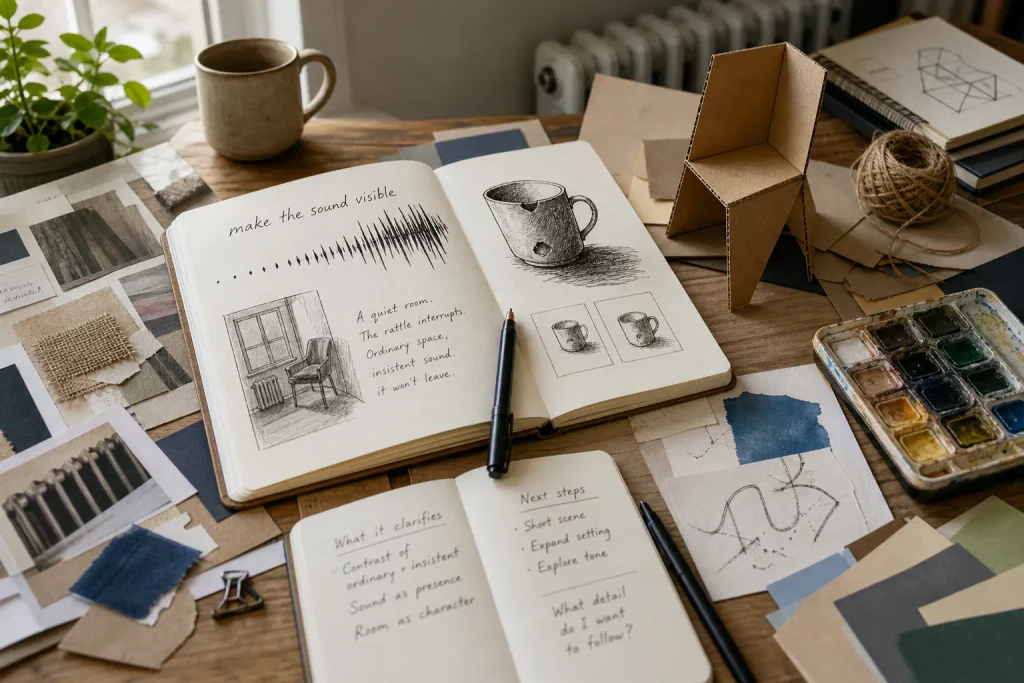
Imagine a person who keeps noticing an uneven radiator rattle and wants to explore it without buying supplies or researching the object. Their hypothetical starting materials are a notebook and pen, and they have a brief stretch of free time. First, they write “make the sound visible” at the top of a page. Next, they draw a row of marks that begins sparse and grows crowded. Then they write a few sentences about how the sound changes the mood of a quiet room. The page now contains both a visual response and a possible setting.
On reviewing the page, they notice that the contrast between an ordinary room and an insistent sound interests them more than the radiator itself. Their resulting decision is to develop that contrast into a short scene; if the sentences had felt more compelling than the drawing, they could instead expand the prose, and if neither held their attention, they could keep the page as a finished experiment. The tradeoff is clear: developing the scene gives the idea more room, while stopping preserves a small, self-contained exercise. These are imagined choices, not a report of a real person’s experience.
Use the first draft to choose what comes next
After making a small draft, ask what it has clarified rather than judging whether it seems impressive. Is there a detail you want to develop, a part that feels unnecessary, or a question the piece has raised? Write that question beside the work. “What would this look like from the other side?” or “Who would notice this sound?” gives you a concrete prompt for another attempt. A specific question makes the next action easier to choose than a broad demand to make the work better.
Decide whether to continue, revise, or close the experiment. Continuing could mean repeating the form with one change; revising could mean keeping the central detail and replacing the rest; closing could mean saving the fragment as a complete exercise. Each choice has a different tradeoff: more exploration, a sharper draft, or a clear stopping point. Starting with a detail, constraint, or rough model gives curiosity something to respond to. The idea does not have to be complete before you begin; making a modest first version can show you whether it is worth pursuing.
Conclusion: let curiosity become something visible
Beginning a creative project does not require a perfect concept, a special supply, or certainty about the final form. Choose a detail that holds your attention, set a manageable constraint, or make a rough model with materials at hand. Then look at what you created and name one thing it has helped you notice. That observation—not a verdict on your talent—can guide the next choice.
If the fragment opens a promising question, follow it with another small draft. If it points somewhere else, change the prompt or medium. If it has said enough, let it remain a complete experiment. Creative work can begin as a practical exchange between attention and action: notice something, make a response, and decide what the response invites you to do.